


On March 12, 2024, I watched a trader in our Discord hit $200K funded capital on FTMO after nine months of grinding through their scaling plan. He started at $100K. His immediate reaction was frustration, not celebration, because he'd just done the math on how long it would take to reach $400K. That reaction tells you everything about how most traders misunderstand prop firm scaling. A prop firm scaling plan isn't just a marketing feature on a landing page. It's the actual mechanism that determines how fast your account grows, what percentage you keep, and whether you'll ever see serious capital behind your trading.
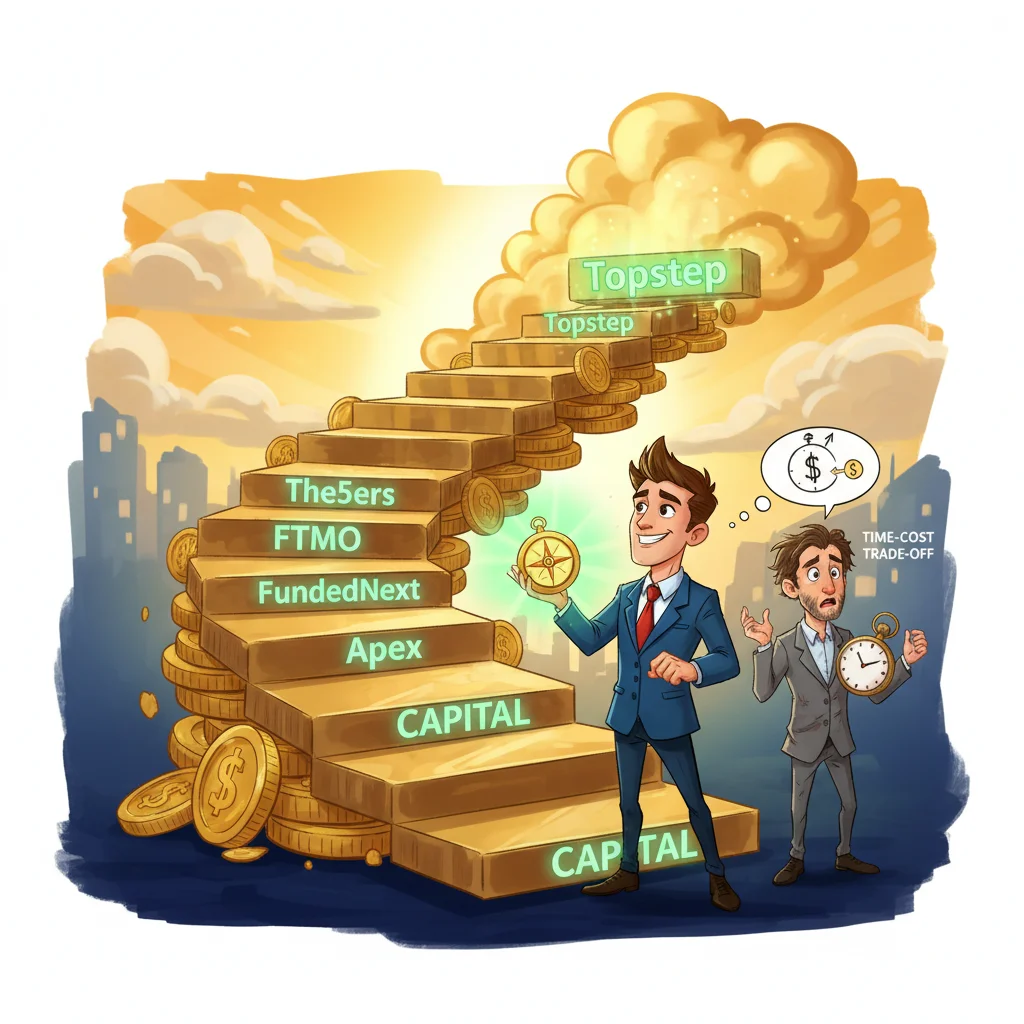
A trader scaled from $100K to $200K on FTMO in nine months—but realized the math on reaching $400K revealed why most traders underestimate the true speed of different prop firm scaling plans.
What Prop Firm Scaling Actually Means (And What It Doesn't)
Most retail traders read 'scaling plan' and think free money. It's not. A prop firm scaling plan is a contractual agreement where the firm increases your funded capital after you meet specific performance targets, usually a minimum profit percentage over a defined period with a set number of profitable months.
The catch is that every firm defines those terms differently. Some scale your single account upward. Others give you additional accounts. A few let you combine both. And the profit splits attached to each tier vary wildly, which matters more than the headline capital number.
Here's what I mean. A $500K account at 70% split earns you $350K on a 10% return. A $300K account at 90% split earns you $270K on the same return. The second number is lower, but the gap narrows fast when you factor in that a smaller account is often easier to manage consistently.
The metrics that actually matter when comparing prop firm account scaling programs:
- Time required to reach max capital from a standing start
- Profit split at each individual tier (not just the final tier)
- Consistency requirements (minimum profitable months, drawdown rules that reset progress)
- Whether violations reset your scaling progress or terminate it entirely
- Maximum capital cap per account or per trader
That last point, the reset clauses, is where traders get burned. Read that section carefully in every firm's terms.

When you realize scaling doesn't mean what you thought it meant.
FTMO Scaling Plan: Reliable But Slow
FTMO's scaling structure is probably the most well-known in the CFD prop firm space, and for good reason. They've been running it since 2018 and the rules haven't changed dramatically, which gives you something rare in this industry: predictability.
Here's how it works. You start at your funded account size (say $100K). Every four months, if you've made at least 10% profit over that period AND had at least two profitable months within it, your account scales up by 25%. So $100K becomes $125K. Then $156,250. Then $195,312. You can see how the compounding works.
Maximum capital per account is $400K. That's a hard ceiling on a single FTMO account. The profit split starts at 80% for standard funded accounts. When you enroll in the scaling plan, that split increases to 90%. That 10% difference on a $100K account running 10% annual returns is $1,000 per year in your pocket, which is not nothing.
The problem is the timeline. Let me run the actual math. If you hit 10% every four months (which is already solid, consistent performance), starting from $100K:
- Month 4: $125K
- Month 8: $156,250
- Month 12: $195,312
- Month 16: $244,140
- Month 20: $305,175
- Month 24: $381,469
- Month 28: $400K (capped)
You're looking at roughly 28 months of consistent performance to hit the cap. Two and a half years. For a disciplined, full-time trader, that's workable. For someone trying to replace a six-figure salary quickly, it's a long road.
Where FTMO genuinely excels is in infrastructure and trust. Their compliance team has been around long enough that you know the rules won't change on you mid-scaling. I've spoken with traders who've been through the full FTMO scale-up and the payout process at $300K+ was straightforward. No games.
The reset clause to watch: if you breach the maximum daily drawdown (5%) or overall drawdown (10%) at any point during the scaling period, you don't just lose that period's progress. Depending on how badly you breach, you may need to repurchase a challenge to restart. Your accumulated scaling history doesn't carry over to a new account.

FTMO's stepping-stone approach requires hitting 10% profit every four months to progress. Slow, steady, and predictable since 2018.
The5ers: The Fastest Path to $1M+ in Funded Capital
The5ers operates on a fundamentally different philosophy than most prop firms. Where FTMO scales a single account, The5ers scales you across multiple accounts simultaneously, and they're explicit about the fact that their prop firm max capital ceiling is $4M. That's not a typo.
Their current structure (as of 2026) starts traders at either $100K or $200K depending on which program you enter. The profit split begins at 50% on the lower-tier programs and 80% on their higher-tier Hyper programs. Here's where it gets interesting: as you scale through tiers, that split moves toward 100%. Yes, 100% profit share at the top tier. The firm makes its money on the challenge fees and the spread, not your profits.
The scaling mechanism works by adding funded accounts rather than always increasing a single account size. Hit your targets, get another account. Those accounts compound, and the targets are based on percentage performance rather than absolute dollar amounts, which means the requirements stay proportional to your account size.
For aggressive traders, particularly swing traders who can hold positions for days to weeks without triggering consistency violations, this is the fastest prop firm scaling path available among CFD firms. A trader who performs consistently over 12-18 months could theoretically reach $500K in total funded capital. The $4M ceiling exists, but very few traders get there, and those who do are running genuinely institutional-quality strategies.
The tradeoff: the early tiers at 50% split feel painful. You're doing all the work and splitting it evenly. You need to be clear-eyed about whether the pathway to the higher tiers is realistic for your trading style before you commit. I'd recommend most traders not enter the base-tier program unless they have at least 12 months of verified trading history showing consistent monthly returns.

The5ers promises the fastest path to $1M+... but patience is still a virtue.
FundedNext Stellar Accounts: The $4M Path With an Eval Bonus
FundedNext entered the space later than FTMO or The5ers, but their Stellar account structure carved out a specific niche: traders who want $4M max capital with an unusual incentive built into the evaluation phase itself.
During the FundedNext evaluation, you earn a 15% profit bonus on whatever you make during the eval phase. This is genuinely rare. Most firms treat the evaluation as a pure hurdle, a filter with no upside. FundedNext turned it into a paid audition. A trader who makes $5,000 profit during a $50K evaluation gets $750 added to their funded account start. Small, but psychologically meaningful.
Once funded, their Stellar accounts scale up to $4M through a series of performance tiers. The profit split structure sits around 80-90% depending on the tier, which is competitive but not as aggressive as The5ers' upper tiers.
The honest assessment: FundedNext is a solid option for intermediate traders who like the psychological carrot of the eval bonus and don't mind a slightly less aggressive scaling timeline compared to The5ers. Their platform stability has improved significantly since their rocky launch period in 2022-2023. By 2025, most of the payout delay complaints had resolved, though you should always verify current user reviews before committing.
One specific warning: their scaling plan documentation changed twice in 2023. Always screenshot and save the terms at the time you sign up. If terms change after you're already funded, you want a record of what you agreed to.
Apex Trader Funding: The Multi-Account Futures Play
Apex operates in futures, not CFDs, and that distinction matters more than most traders realize. Futures have fixed contract sizes, regulated exchanges (CME, CBOT), and real-time price feeds tied to actual markets. There's no spread manipulation possible. The price you see is the price the whole world sees.
Apex's scaling model is built around running multiple Performance Accounts simultaneously. You can hold up to 20 active accounts at once. Each account has its own capital tier ($25K, $50K, $100K, $150K, $250K, $300K). The headline that gets traders excited is this: the first $25,000 in profit on each account pays out at 100%. After that threshold, it drops to 90%.
So the math for an aggressive multi-account trader: 20 accounts, each earning $25K at 100% before dropping to 90%. That's $500K in profit at the top rate, which is an extraordinary structure if you can actually manage 20 simultaneous futures accounts without destroying your risk management.
Most traders can't. I've tried running 4 accounts simultaneously in 2022 and the cognitive load alone caused me to make errors I wouldn't have made on a single account. I took a 4.2% drawdown on one account in a moment of confusion about which account's position I was adjusting. Costly mistake.
For traders who've built systematic or semi-automated strategies in futures (ES, NQ, CL, GC), Apex is genuinely compelling. The scale prop firm account approach here is horizontal, not vertical. You're not growing one big account. You're running a fleet.
Apex's consistency rules are also worth noting: they require 10 trading days of activity on most account types, which is a lower bar than many CFD firms. But their news trading restrictions during FOMC and major economic releases are strictly enforced.

Apex Trader Funding operates on regulated futures exchanges (CME, CBOT) with transparent pricing, eliminating the spread manipulation possible in CFD platforms while enabling simultaneous multi-account scaling.
Topstep: Fixed Account Sizes, Multiple Account Strategy
Topstep is one of the oldest futures prop firms still operating (founded 2012), and their approach to scaling is the most conservative of the group. Account sizes are fixed at $50K, $100K, and $150K. There's no mechanism to grow a single account beyond $150K.
Instead, scaling at Topstep means qualifying for and managing multiple accounts across those fixed tiers. Their consistency rules are strict: you need a minimum number of trading days, no violations of their trailing max drawdown, and a clean performance record before additional accounts are considered.
For the right trader, specifically someone who values stability and regulatory clarity above max capital potential, Topstep works. Their CME partnership and long operating history mean payout reliability is high. But if reaching $1M+ in funded capital is your goal, Topstep is not the vehicle. It's simply not designed for that.
I'd recommend Topstep specifically for traders transitioning from retail to funded futures trading who want to establish a track record before moving to a more aggressive firm. Think of it as the training wheels ramp, not the destination.
Head-to-Head Comparison Table
Here's the data side by side. Numbers reflect 2026 program structures to the best of current knowledge. Always verify directly with each firm before committing capital.
| Firm | Asset Class | Max Capital | Starting Split | Top Split | Time to Max (realistic) | Scaling Mechanism |
|---|---|---|---|---|---|---|
| FTMO | CFDs/Forex | $400K/account | 80% | 90% | 24-30 months | Single account growth |
| The5ers | CFDs/Forex | $4M | 50-80% | 100% | 18-36 months | Multi-account addition |
| FundedNext | CFDs/Forex | $4M | 80% | 90% | 24-36 months | Tiered account scaling |
| Apex Trader | Futures | $300K/account x20 | 90% (after $25K: 90%) | 100% (first $25K/account) | Variable | Multi-account fleet |
| Topstep | Futures | $150K/account | 90% | 90% | N/A (fixed sizes) | Multiple fixed accounts |
A few things jump out from this table. The5ers and FundedNext both advertise $4M max capital, but the path to get there is very different. The5ers gets you there faster if you can maintain performance across added accounts. FundedNext is more straightforward structurally but slower in practice.
Apex's 100% split on the first $25K per account sounds incredible. It is, if you're running 10+ accounts. If you're running one account, the effective split drops to 90% after that first $25K, which is still strong but not as exceptional.
FTMO's $400K ceiling looks limiting compared to the $4M options, but for the vast majority of retail traders, getting to $400K with 90% split represents about $360K per year in profit at a 10% monthly return. That's $36K per month in take-home. Most traders would retire happy at that number.
The Fine Print That Can Reset All Your Progress
Every scaling plan has trap doors. Here are the ones I've seen traders fall through most often.
Reset clauses on rule violations. At every firm listed here, breaching the drawdown rules doesn't just end your current trading period. At FTMO, a hard breach means buying a new challenge. Your scaling history doesn't transfer. At The5ers, similar rules apply, though they have some recovery account options that soften the blow.
Consistency rule violations are subtler. At Apex, if more than 30% of your total profit comes from a single trading day, you can fail a consistency check even if your total numbers look fine. This trips up news traders and people who hold over weekend gaps.
News trading restrictions vary significantly. Topstep and Apex both restrict trading during major economic releases at specific account types. FTMO allows news trading but monitors for patterns that look like high-frequency exploitation.
Withdrawal timing affects scaling too. At FTMO, you need to request withdrawal before the scaling evaluation period ends, or you lose that period's progress toward the 25% bump. This isn't clearly communicated in their marketing. Read the FAQ section of their scaling plan page, not just the main page.
Finally: prop firm industry compliance is still largely self-regulated. The CFTC oversees futures-specific prop firms (Apex, Topstep) more rigorously than CFD firms, since CME-registered instruments fall under their jurisdiction. CFD prop firms (FTMO, The5ers, FundedNext) operate mostly under EU or offshore regulatory frameworks. That doesn't make them fraudulent, but it does mean the legal recourse if something goes wrong is more complicated.

Reading the fine print and discovering what could reset your entire journey.
The Verdict: Which Prop Firm Scaling Plan Actually Wins in 2026
There's no single winner. The best prop firm scaling plan depends entirely on your trading style, time horizon, and risk tolerance. Here's how I'd break down the decision.
Choose The5ers if you're a swing trader with a verified track record who wants to reach $500K+ in funded capital as fast as possible, and you're comfortable managing multiple accounts. The 100% split at upper tiers and $4M ceiling make this the most aggressive scaling path in the CFD space. The early-tier 50% split is the price you pay for that upside.
Choose FTMO if you want reliability, predictability, and a firm that's been paying out consistently since 2018. The $400K cap and 24-30 month timeline to get there is slower, but you'll sleep better knowing the rules won't change on you. For a steady, disciplined trader who treats this like a business rather than a sprint, FTMO remains the benchmark.
Choose Apex Trader Funding if you trade futures with a systematic or semi-systematic approach and can realistically manage multiple accounts. The 100% split on the first $25K per account is a genuinely unique structure in the industry. Five to ten accounts running concurrently at that rate can generate serious income even if individual account sizes aren't massive.
Choose FundedNext if you want a $4M ceiling with a slightly gentler entry point and the evaluation profit bonus appeals to you psychologically. It's a reasonable middle ground between FTMO's reliability and The5ers' aggression.
Avoid treating Topstep as a scaling vehicle. It's a great training ground and a legitimate futures prop firm with real institutional credibility, but its fixed account size structure means it isn't competing in the same category as the others for traders whose goal is maximum capital.
One thing I'd tell any trader reading this: don't choose a firm based on the headline max capital number. Choose based on the profit split at the tier you're most likely to reach in the next 12 months, and the reset clauses you can live with when things go wrong. Because things will go wrong. That's not pessimism. That's twelve years of watching traders blow up.
Disclaimer: This article is for educational purposes only and does not constitute investment advice. Forex and CFD trading carries significant risk of loss. Past performance is not indicative of future results. Always do your own research and consider your financial situation before trading. Never risk money you cannot afford to lose.