


Most South Africans asking 'is forex trading legal in South Africa' are quietly worried they're doing something wrong, and that fear is costing them money. Here's the blunt truth: forex trading is 100% legal for South African residents, full stop. What gets traders into trouble isn't the trading itself, it's ignoring the FSCA, SARB, and SARS rules that sit around it. I'll walk you through every one of those rules in this guide, so you can trade with confidence rather than paranoia.
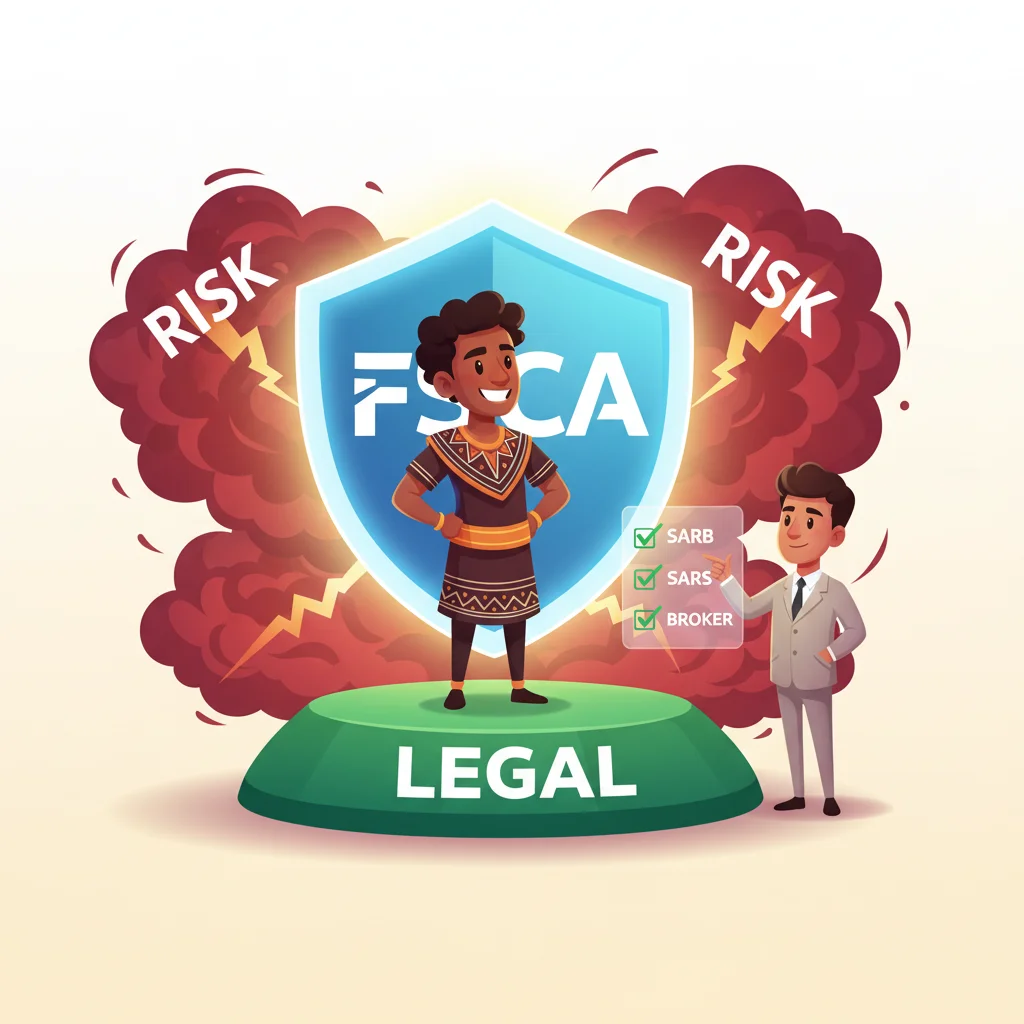
Forex trading is 100% legal in South Africa—but only when you follow FSCA regulations, SARB foreign exchange allowances, and SARS tax requirements. This guide covers all three.
The Legal Status of Forex Trading in South Africa
Forex trading is completely legal for South African residents. There's no ambiguity here, no grey zone, no loophole required. The Financial Sector Conduct Authority (FSCA) formally regulates the forex and CFD industry in South Africa, and its existence alone is proof that the government has accepted retail forex as a legitimate financial activity.
The FSCA was established under the Financial Sector Regulation Act of 2017, replacing the old Financial Services Board (FSB). If you've been trading for a while, you'll remember brokers advertising their FSB licenses. Same body, new name, stronger mandate.
What makes something illegal is trading through an unlicensed provider, not the act of trading itself. A broker operating in South Africa without an FSCA license is breaking the law. You, the retail trader, are in the clear as long as you're not running an unregistered financial services business yourself.
I spent a good chunk of 2019 trading through an offshore broker that had no FSCA license. I didn't know better. When I had a withdrawal dispute, I had zero recourse. The FAIS Ombud (the free dispute resolution service for FSCA-regulated brokers) couldn't touch my case because my broker wasn't in their jurisdiction. That's a mistake I won't repeat, and I don't want you making it either.

When you discover forex trading is actually legal in SA (and you've been worried for nothing).
How FSCA Forex Regulation Actually Works
The FSCA licenses forex and CFD providers as Financial Services Providers (FSPs) under the Financial Advisory and Intermediary Services Act (FAIS Act). This is the core of FSCA forex regulation in South Africa.
To get an FSP license, a broker has to meet minimum capital requirements, keep client funds in segregated accounts, submit to regular audits, and employ staff who pass regulatory competency exams. These aren't easy boxes to tick. A lot of the bucket-shop operations you see advertising on social media can't meet these standards, which is exactly why they don't bother trying.
Here's what the FSCA license gives you as a trader:
- Your funds must be held separately from the broker's own operational money
- You have access to the FAIS Ombud for free dispute resolution
- The broker must give you full disclosure of fees, risks, and terms
- You're protected under the Treating Customers Fairly (TCF) framework
You can verify any broker's FSCA status right now at the FSCA's online FSP register (fsca.co.za). Search the broker's name or their FSP number. If they don't appear, don't deposit.
Some well-known brokers with active FSCA licenses as of 2026 include FP Markets ZA, AvaTrade, HotForex (HF Markets), IG Markets, and IC Markets' South African entity. Exness holds an FSCA license as well. These aren't endorsements, just examples of names you'll recognise that have gone through the proper process.
One thing traders get confused about: a broker can be regulated in another country (say, by the FCA in the UK or CySEC in Cyprus) without holding an FSCA license. Being FCA-regulated is genuinely strong regulation. But it does not give you access to South Africa's FAIS Ombud. That matters when things go wrong at 2am and you need someone to call.
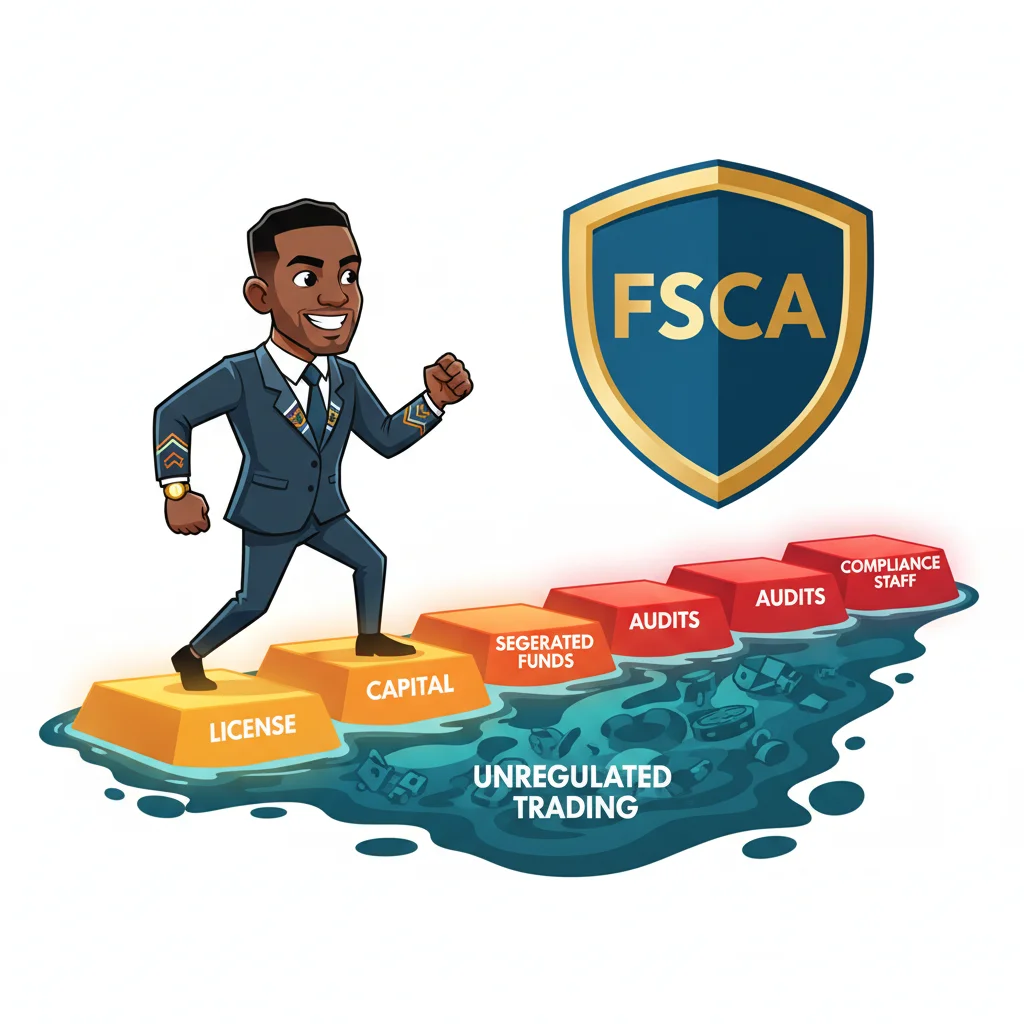
FSCA-regulated brokers must navigate five critical compliance requirements—from minimum capital standards to staff regulatory competency—to earn their FSP license and legally operate in South Africa.
SARB Rules: Your Annual Foreign Exchange Allowances
This is where most traders get tripped up. The South African Reserve Bank (SARB) controls how much money South African residents can send offshore each year, and deposits to forex brokers count against these limits.
Here's the structure for 2026:
- Single Discretionary Allowance (SDA): R1 million per calendar year, no tax clearance needed, covers any legal purpose including forex broker deposits
- Foreign Investment Allowance (FIA): R10 million per calendar year, requires a tax clearance certificate from SARS before the transfer
So in total, you can move up to R11 million offshore per year if you have clean tax affairs. For most retail traders, the R1 million SDA is all you'll ever need.
The practical reality: when you fund a forex broker account abroad, your bank or SWIFT transfer is recorded. If you exceed the SDA without using the FIA process, SARB can flag the transaction. I've spoken to traders who got letters from their banks asking them to justify transfers. It's not a criminal matter in most cases, but it creates paperwork headaches you don't need.
A few important SARB forex rules points:
- Transfers must go through an Authorised Dealer (your South African bank)
- You cannot use cryptocurrency to move money offshore as a workaround to these limits (this is a common misconception in SA trading communities)
- The R1 million SDA resets every January 1
- If your broker is South African and FSCA-licensed, local ZAR deposits don't necessarily trigger SARB cross-border rules in the same way
I know a trader in Cape Town who blew through his R1 million SDA by August one year because he was funding and refunding his account after losses. He had no idea the cumulative deposits all counted. Don't be that guy.
Forex Tax in South Africa: What SARS Wants From You
Nobody likes this section. But skipping it is how traders end up with SARS debt.
Forex profits are taxable income in South Africa. SARS (South African Revenue Service) treats forex trading profits as revenue income, not capital gains, for most retail traders. That means your profits get added to your total annual income and taxed at your marginal rate, which can be as high as 45% for income above R1,817,000 in 2026.
Here's a simplified breakdown of how forex tax south africa works:
- If you earn R500,000 from your job and R200,000 from forex trading, SARS views your total taxable income as R700,000
- You pay income tax on R700,000 at the applicable rates
- Losses can generally be offset against other income in the same year, but SARS can challenge this if they deem trading a hobby rather than a genuine business
The 'speculator vs business' distinction matters. SARS classifies most retail forex traders as speculators by default. If you've registered a formal trading business (a PTY Ltd, for example), your trading income may qualify as business income, giving you access to business expense deductions like data costs, trading software, education, and a portion of home office costs. Without that structure, you're declaring speculative income on your ITR12 return under 'other income'.
Common mistakes traders make with SARS:
- Not declaring profits at all (this is tax evasion, a criminal offence)
- Assuming offshore profits are invisible to SARS (they're not, especially post-OECD Common Reporting Standards)
- Claiming losses from a hobby trading account against salary income without proper documentation
I'm not a tax advisor, and you should speak to one who understands forex before filing your first return. The cost of a consultation (usually R1,500 to R3,000 in South Africa) is far cheaper than a SARS audit. This is one area where cutting corners genuinely costs you.

Trying to figure out exactly how much SARS wants from your forex profits.
FSCA-Licensed Brokers vs Offshore Brokers: The Real Difference
Using an offshore broker that's regulated elsewhere isn't technically illegal for a South African retail trader. I want to be honest about that. You won't get arrested for opening an account with a broker licensed only by the FCA or ASIC.
But here's what you lose:
- No FAIS Ombud protection
- No guarantee of TCF compliance under SA law
- No local legal recourse if the broker goes under or freezes your account
The risk isn't hypothetical. Between 2020 and 2023, I watched traders in South African forex communities lose money to offshore brokers that simply stopped processing withdrawals. Some of these brokers had flashy websites and 'offshore regulation' from jurisdictions that are rubber stamps (Vanuatu, Seychelles, Belize). Real regulation from the FCA, CySEC, or ASIC is legitimate. Regulation from a tiny island nation with no enforcement capacity is not.
My personal rule: if I'm going to use a broker without an FSCA license, it needs to be regulated by at least one of the FCA (UK), ASIC (Australia), or CySEC (EU). Those regulators actually enforce rules and have compensation schemes. Everything else is a gamble with your capital, not a trading position.
For beginners especially: start with an FSCA-licensed broker. The extra protection is worth whatever minor differences exist in spreads or platform features.
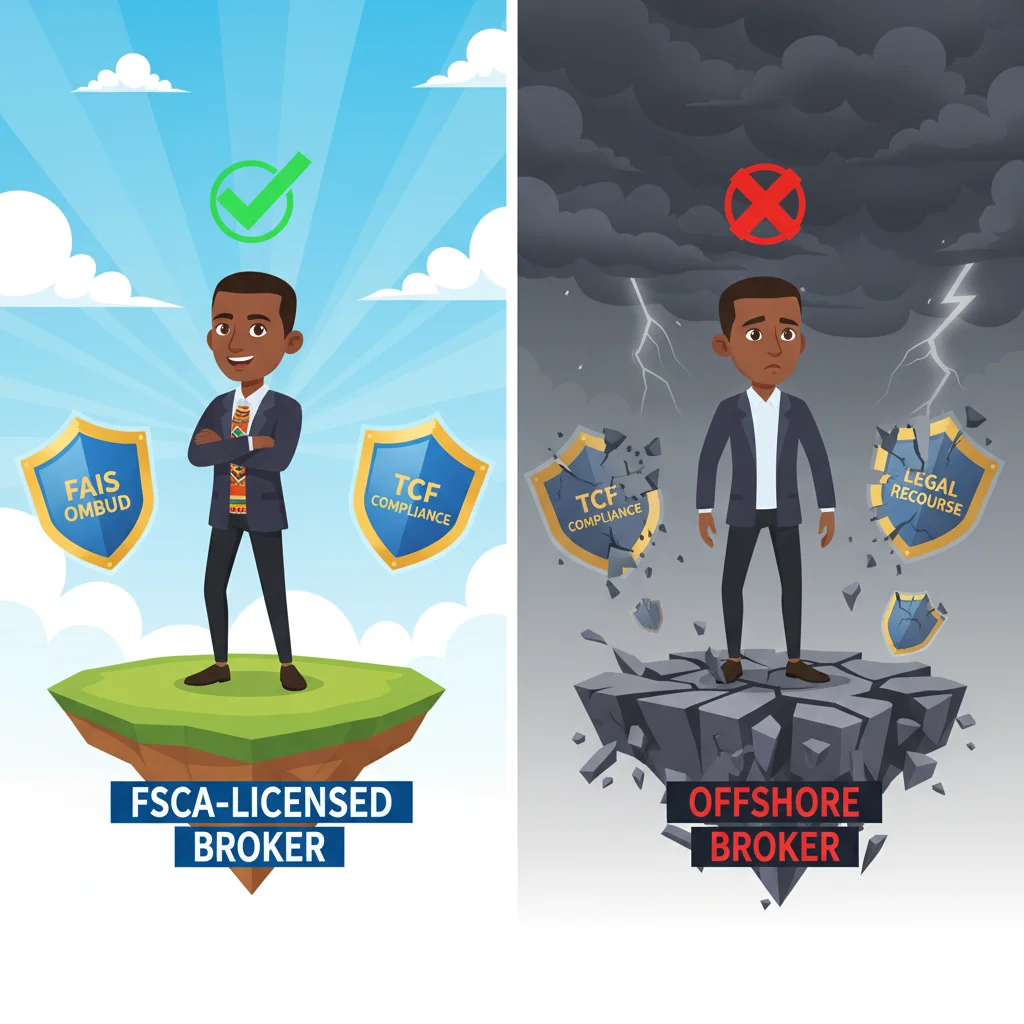
FSCA-licensed brokers provide FAIS Ombud protection and local legal recourse that offshore brokers simply cannot offer South African traders.
Are Prop Firms Legal in South Africa?
Yes. Proprietary trading firms like FTMO, FundedNext, and The5ers are fully legal for South African residents.
Prop firm trading has exploded in popularity in South Africa, and I get why. The core appeal: you pay an evaluation fee (typically $100 to $600 USD), pass a challenge, and trade the firm's capital. Your own money isn't at risk beyond the evaluation fee. Profits are split, usually 80/20 or even 90/10 in your favour.
From a SARB perspective, the evaluation fee counts as a foreign payment subject to your SDA. Your profit payouts come back into South Africa as foreign income, which must be declared to SARS. Simple enough.
The legal grey area isn't in South Africa, it's with the firms themselves. FTMO, FundedNext, and The5ers are not FSCA-licensed brokers. They don't need to be, because you're not depositing trading capital with them. You're buying an evaluation service. The regulatory distinction matters.
What I'd watch out for: some South African-based 'prop firms' have sprung up in recent years that are thinly veiled investment scams. If a local company is asking you to 'invest' in a prop fund and promising returns, that's a different animal entirely and likely falls foul of the FSCA's collective investment scheme rules. Stick to the established international names.
Three Mistakes That Get South African Traders Into Trouble
After years of trading and talking to hundreds of traders in South Africa, the same three mistakes come up constantly.
Mistake 1: Using Unregulated Offshore Brokers This is the biggest one. I made this mistake myself in 2019 trading EUR/USD on a Seychelles-registered broker. I deposited $2,000, had a withdrawal rejected, and spent three months emailing a support desk that eventually stopped responding. That money is gone. The FSCA couldn't help me. The Seychelles FSA couldn't help me. Lesson learned at significant cost.
Mistake 2: Not Declaring Forex Profits to SARS This one surprises newer traders. They assume that because the broker is offshore and payments are in USD, SARS somehow can't see it. SARS has access to banking data and, under the OECD's Common Reporting Standards, receives information on South African account holders from foreign financial institutions. The idea that offshore income is invisible to SARS hasn't been true for years. Undeclared forex income is tax evasion. The penalties start at 150% of the unpaid tax, plus interest.
Mistake 3: Exceeding the SARB Annual FX Allowance Without Realising It As I mentioned in the SARB section, cumulative broker deposits count. A trader who deposits R200,000, withdraws it after a bad month, then deposits again four times in a year has moved R800,000 offshore through that single SDA. Add any other foreign payments (holidays, online subscriptions, international transfers) and you can hit R1 million faster than you expect. Track your transfers. Your bank should be able to give you a year-to-date total on foreign transfers at any point.

Realizing you've been making one of those three rookie mistakes this whole time.
Your Step-by-Step Plan to Trade Forex Legally in South Africa
Right. You've got the context. Here's how to actually get started correctly, from zero to compliant trader.
Phase 1: Set Up Your Legal Foundation (Week 1-2)
- Check your tax status. Make sure your SARS tax affairs are in order. If you have outstanding returns, sort them before you start trading. You want a clean record.
- Open a separate bank account for forex-related transfers. This makes tracking your annual SDA usage simple and keeps your trading finances separate for tax purposes.
- Speak to a tax practitioner who knows forex. Budget R1,500 to R3,000 for an initial consultation. Worth every cent.
Phase 2: Choose Your Broker (Week 2-3)
- Go to fsca.co.za and verify the FSP license of any broker you're considering.
- Shortlist brokers with genuine FSCA licenses. As of 2026, FP Markets ZA, HF Markets, AvaTrade, IG Markets, and IC Markets' South African entity are among the verified options.
- Open a demo account first. Trade it for at least three weeks before putting real money in.
Phase 3: Fund and Track (Week 3-4)
- Keep your initial deposit modest. R5,000 to R20,000 is enough to trade micro lots and learn without exposing yourself to catastrophic losses.
- Record the date and amount of every transfer to your broker. Note your running SDA total against the R1 million annual limit.
- Keep copies of all transfer receipts and SWIFT confirmations.
Phase 4: Tax Compliance (Ongoing)
- Keep a trading journal that records every trade: date, pair, entry price, exit price, profit/loss in ZAR.
- At year end, calculate your total net profit or loss and report it on your ITR12 under 'other income' (or as business income if you're trading through a registered entity).
- If you're making consistent profits above R50,000 per year from trading, seriously consider registering a trading business. The tax efficiency of deductible expenses can be meaningful at that level.
This isn't a quick process. But getting it right from the start means you can trade for years without SARB or SARS breathing down your neck.
Disclaimer: This article is for educational purposes only and does not constitute investment advice. Forex and CFD trading carries significant risk of loss. Past performance is not indicative of future results. Always do your own research and consider your financial situation before trading. Never risk money you cannot afford to lose.