

I blew four FTMO challenges back-to-back in 2021, dropping a combined $1,400 in evaluation fees before I finally figured out what was killing me. The third attempt hurt the most: I was up 7.8% on day 24 of a 30-day window, needed 10% to pass, and I doubled my lot size out of impatience. Breached the daily drawdown limit by 0.3% the very next morning. If you're serious about learning how to pass a prop firm challenge, you need to understand that this is less about finding the perfect entry and more about surviving a ruleset that's specifically designed to expose bad habits.

Most traders fail prop firm challenges not by missing profits, but by breaking risk rules. This guide breaks down the exact survival mechanics that separate the 4% who pass from the 96% who don't.
Why Most Traders Fail the Challenge (The Real Numbers)
The industry average pass rate sits between 8% and 15%. FTMO has publicly hinted their overall pass rate is around 10%, and that number has held pretty steady across the prop firm space. That means 85-92% of people who pay for a challenge never see a funded account. Let that sink in.
But here's what nobody tells you: most people don't fail because of bad trading. They fail because of bad challenge management. I've talked to dozens of traders who had solid live trading records and still couldn't pass a funded trader challenge. The evaluation environment is different. You're trading under a ruleset with hard floors, and one bad day can end a 28-day run.
The three rules that kill the most traders are:
- Daily drawdown limit: Typically 4-5% of account equity. At FTMO, it's 5% on a $100k account, meaning you can't lose more than $5,000 in a single trading day. Sounds manageable. It isn't when you're overleveraged.
- Maximum (overall) drawdown: Usually 8-10% from initial balance. At MFF (MyForexFunds, now restructured), it was 8%. Hit this once and the challenge is over, no reset.
- Minimum trading days: Most firms require 4-10 active trading days. Traders who have a big early week sometimes try to coast, then get bored and overtrade on day 28.
The daily drawdown is the biggest killer. In my second failed challenge, I had three losing trades on a Friday afternoon (classic mistake, don't trade Friday afternoons), and I was down 4.7% by 3 PM EST. Closed everything. Barely survived. Came back Monday and did the exact same thing. Game over.
Understanding why people fail is step one. Now let's build the system to avoid it.

When you realize why 90% of traders don't make it past day one.
Choosing the Right Prop Firm for Your Style
Not all challenges are built the same, and picking the wrong firm for your trading style is a fast way to lose your evaluation fee.
Here's a quick breakdown of the major players in 2026:
FTMO: $100k account challenge costs $540. 10% profit target in Phase 1, 5% in Phase 2. 5% daily drawdown, 10% max drawdown. Minimum 4 trading days per phase. They allow news trading, but you need to check their current terms (they've tightened this in the past).
MyFundedFutures (MFF) / Apex / Topstep: These are futures-focused. If you're a forex trader, these aren't your target. Stick to forex-specific firms.
FundedNext: Popular with USD-based traders. Offers a 15% profit split in the challenge phase itself (yes, you get paid during evaluation). Their Stellar Challenge has an 8% profit target and 5% daily / 10% max drawdown. Worth considering if you're newer.
The Funded Trader (TFT): Offers a Royal Challenge with more relaxed rules. Their swing accounts remove overnight and weekend holding restrictions, which matters a lot if you trade H4 or daily charts.
My honest recommendation: if you're a swing trader who holds positions 1-4 days, go with a firm that explicitly allows overnight holds and has a swing account option. If you try to run H4 strategies on an account that penalizes overnight exposure, you'll be cutting winners short and that's where the pass FTMO challenge attempt falls apart for most swing traders.

Choosing the right prop firm matters—FTMO's $540 challenge with 10% profit target suits disciplined scalpers, but aggressive day traders might need different drawdown rules.
Position Sizing: The One Thing You Can't Ignore
I'll be blunt: if you're risking more than 0.5% per trade during a challenge, you're already in trouble.
Here's the math on a $100,000 challenge account:
- 0.25% risk per trade = $250 max loss per trade
- 0.5% risk per trade = $500 max loss per trade
- 1% risk per trade = $1,000 max loss per trade (this is too high during a challenge)
At 1% risk, you only need five consecutive losers before you've hit 5% drawdown and you're uncomfortably close to the daily limit on a bad morning. At 0.5%, ten losers in a row gets you there. That almost never happens if you're trading a decent setup.
The position sizing formula you need:
- Take your account balance (say $100,000)
- Multiply by your risk percentage (0.5% = $500)
- Calculate your stop loss in pips
- Divide $500 by (stop loss pips x pip value)
Example: EUR/USD trade, 30-pip stop loss. Standard lot pip value is $10. So: $500 / (30 x $10) = 1.67 lots. You'd round down to 1.6 lots.
I personally stick to 0.25-0.3% per trade during challenges. Yes, it feels like nothing. Yes, it makes the profit target harder to hit. But it also means I can take 15-20 losses without touching a danger zone. That mental breathing room is worth more than any edge you think you get from sizing up.
Martingale is an absolute no. Grid trading is a no. Both of these strategies have open-ended loss potential that will hit your max drawdown in one bad sequence. I've seen traders lose a funded account in four hours using grid systems. Don't do it.
Scalping is technically allowed at some firms, but most require a minimum 2-minute hold time, and the stress of scalping during an evaluation causes emotional decisions. Save the scalping for after you've passed.

You, carefully calculating your position size like your challenge depends on it (because it does).
The Best Timeframes and Strategies for Challenges
Stick to H1 and H4. This isn't a personal preference, it's practical advice based on what the challenge structure rewards.
Challenge accounts have minimum trading day requirements (usually 4-10 days). If you're a daily chart trader, you might only generate 2-3 signals per month and you'll be sitting idle or forcing trades to hit the minimum. H1 and H4 give you enough signals to stay active without the noise of the 5-minute and 15-minute charts.
Strategy 1: Trend-Following on EUR/USD (H1)
EUR/USD is the most liquid forex pair in the world, with an average daily range of 80-100 pips. The strategy is simple: identify the trend using a 50 EMA and 200 EMA crossover on H1. Only take trades in the direction of the trend. Enter on a pullback to the 50 EMA with confirmation (a bullish or bearish engulfing candle works fine). Set your stop 10-15 pips below the swing low. Target 2:1 reward-to-risk minimum.
This isn't exotic. It works because you're trading with momentum, not against it, and EUR/USD has tight spreads (usually 0.1-0.3 pips at most brokers), so your transaction costs don't eat your edge.
Strategy 2: XAU/USD Swing on H4
Gold is volatile, which scares a lot of challenge traders. But that volatility is your friend when you size correctly. On H4, XAU/USD regularly makes 200-400 pip moves that last 2-5 days. The approach: wait for a clear higher-high / higher-low structure (or lower-high / lower-low for shorts), enter on the break of a consolidation zone with a 40-60 pip stop, target the next major structure level.
At 0.25% risk on a $100k account ($250), a 40-pip stop on XAU/USD means you're trading roughly 0.06-0.07 lots. A 150-pip winner at that size returns about $900-$1,050, which is close to 1% on the account. Three or four trades like that and you're making serious progress toward your profit target.
Avoid news trading unless you know the specific firm's rules cold. FTMO allows news trading but some traders have had trades voided for entering within two minutes of high-impact events. The MFF challenge pass rules historically were strict about this. Check the current terms before every trade around NFP, CPI, or FOMC.
Your 30-Day Challenge Calendar (Week by Week)
Most challenges give you 30 calendar days. Here's how to structure that time so you're not scrambling on day 29.
Week 1 (Days 1-7): Conservative Foundation Target: reach 2-3% profit. Risk 0.25% per trade. Trade your A+ setups only. No FOMO entries. The goal this week isn't to get ahead, it's to build a buffer and get trading days on the board. Aim for 2-3 active trading days minimum.
Week 2 (Days 8-14): Build Momentum Target: reach 5-6% cumulative profit. You can slightly increase to 0.35% risk if week 1 went well and you haven't touched 2% drawdown yet. Still no revenge trading. If you have a losing day, take the next day off entirely. Write in a journal (I know it sounds soft, but it changed my results).
Week 3 (Days 15-21): Maintain and Protect Target: reach 7-8% profit. This is where most traders blow it. You're close to the target and the temptation to "just get there" spikes. Don't. Keep the same position size. Don't add extra trades. The challenge isn't about getting there fast, it's about getting there without breaching drawdown.
Week 4 (Days 22-30): Close It Out Target: cross the 10% profit target cleanly. If you're at 8% by day 22, you only need 2% in 8 days. That's nothing if you stay disciplined. If you're at 5% by day 22, you need to assess honestly whether you can reach 10% with controlled risk. Sometimes the right call is to accept that this attempt won't pass and protect your drawdown for a reset (some firms offer resets).
A few non-negotiables for the whole 30 days:
- No trading Friday after 3 PM EST (liquidity drops, spreads widen, stop hunts increase)
- No trading the Sunday open unless you have a specific reason
- Daily drawdown check every morning before you open any chart. Know your number before the session starts.
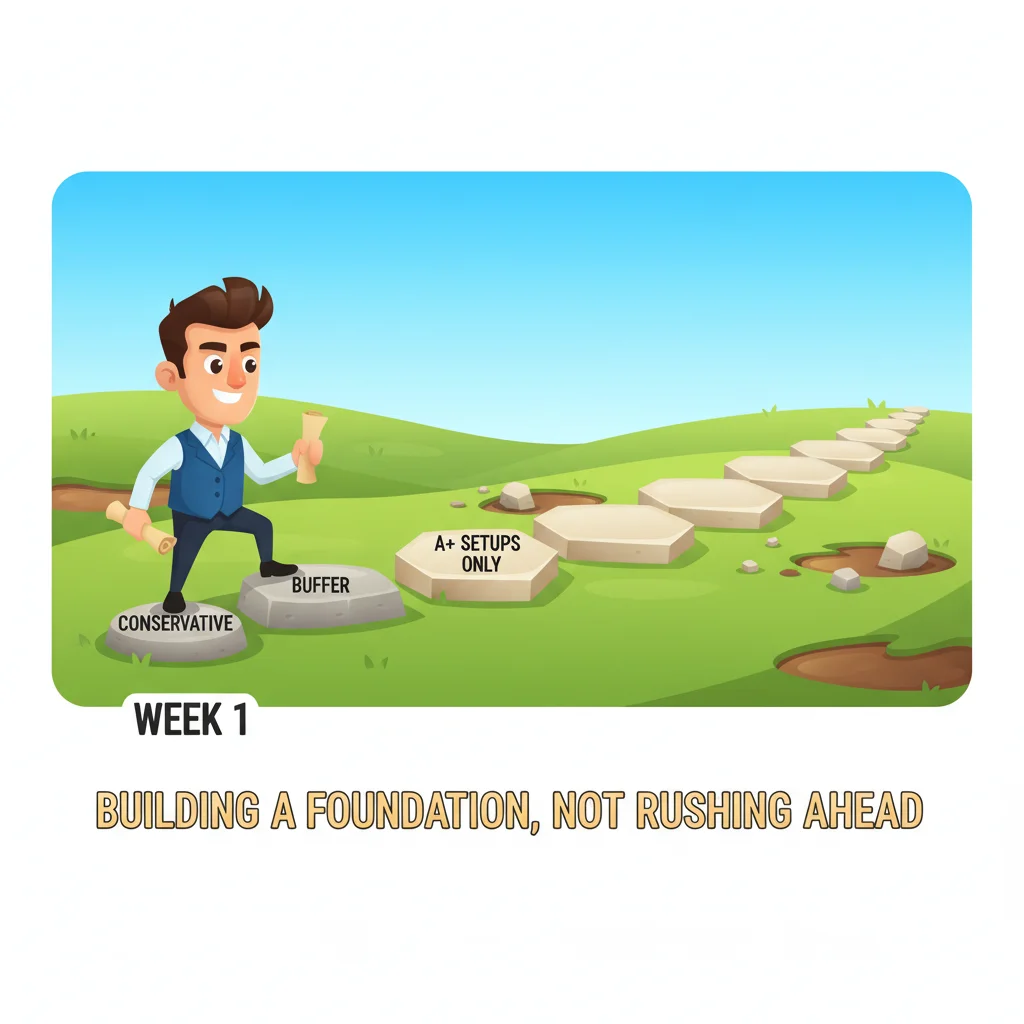
Week 1 is about laying a solid foundation with 2-3% profit targets and strict 0.25% risk per trade—slow and steady wins the prop firm challenge.
The Psychological Traps That End Challenges
This is the section I wish someone had written for me before my first four failures.
The biggest psychological trap is revenge trading after a loss. You're down $600 on a bad EUR/USD trade and your brain immediately wants to get it back. You find a setup that's a 6/10 at best, enter it with double the normal size, and now you're down $1,800. That's how a single loss becomes a challenge-ending session.
The second trap is "profit target tunnel vision." You're at 9.2% on day 27 and you need 0.8% more. You start taking trades you'd normally skip. You enter before confirmation. You hold through a reversal because you need those extra pips. I lost my fifth challenge this way before finally passing. Was at 9.4% with two days left. Took a bad gold trade, gave back 1.8%, and finished below my starting equity curve for the week.
The third trap is comparison. Reddit and Discord are full of people posting their challenge wins. You don't see the ten failures before that win. You see someone hitting 10% in 8 days and you try to replicate it. Don't. Trade your own system at your own pace.
What actually helped me: I set a hard rule that if I lost two trades in a row on the same day, I closed the platform. Done. No exceptions. That rule alone probably saved my sixth challenge (the one I finally passed in March 2022 on a $50k FTMO account, ending at 10.6% profit with zero daily limit breaches).
News Events and When to Stay Out
High-impact news is the fastest way to blow through a daily drawdown limit in under 60 seconds. I've seen EUR/USD move 80 pips in two minutes on a surprise CPI print. If your stop was 20 pips and you got slipped, that's four times your planned loss in one candle.
The events you always need to check:
- Non-Farm Payrolls (NFP): First Friday of every month, 8:30 AM EST. Stay out 30 minutes before, 15 minutes after.
- FOMC Rate Decisions: Eight times per year. The press conference at 2:30 PM EST is often more volatile than the decision itself.
- CPI releases: Monthly. These have been the most market-moving data points since 2022.
- ECB and Fed Chair speeches: Can whipsaw EUR/USD 50+ pips with no warning.
I use Forex Factory's economic calendar and filter for red (high impact) events only. Every Sunday evening I mark the week's red events on my chart. Those times are no-trade zones during a challenge. Period.
Some prop firm challenge strategy guides will tell you to trade the news because the moves are bigger. That's true. The losses are also bigger. During a challenge, your job is capital preservation first, profit second. Skip the news, take the boring setup two hours later when the dust has settled.
After You Pass: What Actually Changes
Passing the challenge is not the finish line. I want to be honest about this because a lot of people treat the funded account like it's free money.
When you get funded, the psychological weight actually increases. You're now trading real firm capital, and the rules still apply. Most funded accounts have the same drawdown limits as the challenge. The difference is that your profit split (typically 70-90% depending on the firm and tier) means you're now earning real money on those gains.
A few things that change after you pass:
- Your profit splits start accumulating. At FTMO, the standard split is 80%. On a $100k account, a 5% monthly gain is $5,000 in profit, and you keep $4,000. That's meaningful income if you can do it consistently.
- Scaling plans kick in. FTMO and FundedNext both offer account scaling if you hit consistent monthly targets. Some traders have scaled from $100k to $400k over 18-24 months.
- You need to stay within rules indefinitely. There's no "I passed, now I can relax" phase. The daily drawdown and max drawdown limits follow you. Funded traders lose their accounts too, and it happens more often than firms advertise.
My advice after passing: trade the funded account exactly like you traded the last week of the challenge. Same size. Same caution. The habits that got you through are the habits that keep the account alive.
Disclaimer: This article is for educational purposes only and does not constitute investment advice. Forex and CFD trading carries significant risk of loss. Past performance is not indicative of future results. Always do your own research and consider your financial situation before trading. Never risk money you cannot afford to lose.

That moment when you pass the challenge and realize everything actually changes.