



Half the trading forums in India will tell you that forex is either completely illegal or that you need an offshore broker to make real money. Both claims are wrong, and believing either one will either keep you on the sidelines or get you into serious FEMA trouble. Indian traders have perfectly legal access to currency derivatives on NSE and BSE, covering USD/INR, EUR/INR, GBP/INR, and JPY/INR. In this guide, I'll walk you through 5 forex trading strategies for beginners in India that actually work within the rules, with real risk management numbers built for INR accounts.

Indian traders can legally access currency derivatives on NSE and BSE for USD/INR, EUR/INR, GBP/INR, and JPY/INR—no offshore brokers needed. These 5 proven strategies work within India's regulatory framework.
What Indian Traders Can Actually Trade (And What's Off-Limits)
Before we touch any strategy, you need to know the legal boundary. SEBI and RBI are very clear: Indian residents can trade currency futures and options only on recognised exchanges (NSE, BSE, MSE) and only in four pairs: USD/INR, EUR/INR, GBP/INR, and JPY/INR. Cross-currency pairs like EUR/USD are also now permitted on Indian exchanges, which opened up a few more opportunities after 2018.
Offshore brokers advertising EUR/USD, GBP/USD, or gold CFDs to Indian residents are operating in a grey zone at best and a FEMA violation at worst. I've personally spoken to traders who received income tax notices after wire transfers to offshore platforms showed up in their bank statements. The penalty under FEMA can go up to three times the sum involved. That's not a risk worth taking when you have perfectly good instruments sitting on NSE.
For currency futures on NSE, the lot size is USD 1,000 for USD/INR (so one lot at Rs 83 means roughly Rs 83,000 notional exposure). Margin requirements typically run between 1.5% to 3%, meaning you need around Rs 1,200 to Rs 2,500 to control one lot, depending on volatility at the time.
Recommended platforms for legal forex trading in India: Zerodha (Kite), ICICI Direct, HDFC Securities, Angel One, and Upstox all give you access to NSE currency derivatives. Zerodha's Kite is my personal preference for charting because the interface is clean and you can set up technical indicators without paying extra for third-party tools.
Tax treatment is one thing traders almost always get wrong. If you're actively trading currency futures (more than a handful of trades a month), the Income Tax Department treats your profits as business income, not capital gains. You'll need to file ITR-3, maintain a trading journal as a business record, and you can claim brokerage, internet, and data costs as deductions. Get a CA who understands trading income before your first filing.

When you realize some forex pairs are completely off-limits for Indian traders. Time to figure out what's actually tradeable!
Strategy 1: Trend-Following with the 50 EMA on Daily Charts
This is the first strategy I'd give to any beginner. Simple. Forgiving. Works across all four legal pairs.
The setup is straightforward. Pull up the daily chart of USD/INR on Kite or TradingView (you can use TradingView for charting even if you execute on Zerodha). Add a 50-period Exponential Moving Average. When price is above the 50 EMA and pulling back toward it, you look for a long entry. When price is below and bouncing up toward it, you look for shorts.
The entry rule: Wait for a daily candle to close within 10-15 paise of the 50 EMA. Enter the next morning when the market opens (9:00 AM IST for currency futures). Place your stop-loss 20 paise below the EMA for longs, 20 paise above for shorts. Target is 40-60 paise in the direction of the trend, giving you a minimum 2:1 reward-to-risk ratio.
A real example: In late October 2023, USD/INR was in a clear uptrend on the daily chart. The 50 EMA was sitting around 83.10. Price dipped to 83.15 on October 24th before bouncing. Entry at 83.20 the next morning, stop at 82.90, target at 83.80. USD/INR hit 83.78 within 12 trading days. On two lots (Rs 2,400 margin approximately), that's roughly Rs 1,160 profit after brokerage.
The honest limitation: this strategy gives you a lot of false signals during sideways markets. USD/INR often chops around in a 50-paise range for weeks, especially around RBI intervention zones. If the 20-day Average True Range (ATR) is below 25 paise, I skip the trade entirely because the whipsaw risk is too high.

The 50 EMA trend-following strategy works across all four legal Indian forex pairs, rewarding entries when price pulls back to the moving average on daily charts.
Strategy 2: Support and Resistance Bounces on the H4 Chart
This is probably the most popular easy forex strategy among Indian retail traders, and for good reason. It doesn't require any fancy indicators and it forces you to think about price in a logical way.
On the H4 (4-hour) chart of USD/INR, mark the two or three most obvious horizontal levels where price has reversed at least twice before. These become your zones. When price approaches one of these zones again, you wait for a confirmation candle (a pin bar or engulfing candle) before entering.
Why H4 specifically? Because currency futures in India have their best liquidity between 9:00 AM and 5:00 PM IST. A 4-hour chart gives you 2 candles in the morning session and 2 in the afternoon, which is enough data to make a real decision without overtrading.
Position sizing in INR terms: Let's say you have a Rs 2,00,000 account and you're risking 1.5% per trade. That's Rs 3,000 maximum risk. If your stop is 30 paise away and one lot of USD/INR = Rs 1 per paise move (actually it's roughly Rs 1 per paise on a 1,000 USD lot), then you can take up to 3 lots. Always calculate this before you place the order, not after.
I got burned badly in August 2022 ignoring this discipline. I took 5 lots on a GBP/INR support bounce without calculating my actual rupee risk. The trade went wrong and I lost Rs 8,400 in one trade on a Rs 1,20,000 account. That's 7% in one shot. Took me 6 weeks of grinding to recover. Don't be me.

Tracking those support and resistance bounces like a hawk—steady gains, one bounce at a time.
Strategy 3: RSI Divergence on the 1-Hour Chart
RSI divergence sounds technical but it's one of the most intuitive signals once you see it a few times. When price makes a new low but RSI makes a higher low, that's bullish divergence. Price is falling but momentum is weakening. A reversal is likely coming.
For Indian traders, this works beautifully on USD/INR during the morning session (9:00 AM to 1:00 PM IST) when RBI tends to be less active in the market. Set your RSI to 14 periods on the 1-hour chart. Look for divergence that forms over at least 4 to 6 candles (so 4-6 hours). Smaller divergences on 2-candle patterns are unreliable.
Entry: Enter on the candle after the RSI crosses back above 30 (for bullish divergence) or below 70 (for bearish). Stop goes below the most recent swing low. Target is the nearest resistance zone.
This is not a high-frequency strategy. You might see a clean setup once or twice a week on USD/INR H1. That's fine. Beginners almost always overtrade, and RSI divergence naturally filters out the noise because you're waiting for specific conditions to align.
One honest warning: RSI divergence fails often in strong trending markets. If USD/INR is in a sustained one-directional move (like the depreciation run from 79 to 83.50 between mid-2022 and early 2023), you'll get bullish divergence signals every few days that all fail. In trending conditions, only trade divergence in the direction of the major trend, or skip this strategy altogether and use the 50 EMA method instead.
Strategy 4: The London Breakout at 13:30 IST
This one is specifically suited to how Indian forex trading hours align with global sessions. London opens at 8:00 AM GMT, which is 1:30 PM IST. That's when EUR/INR and GBP/INR really start moving because the underlying EUR/USD and GBP/USD pairs are getting massive volume from European institutional players.
The strategy is simple. From 9:00 AM to 1:30 PM IST, mark the high and low of EUR/INR or GBP/INR on a 15-minute chart. That's your pre-London range. At 1:30 PM IST sharp, if price breaks above the range high, you go long. If it breaks below the range low, you go short. Stop goes on the opposite side of the range. Target is 1.5x the range size.
Example: On a typical day, suppose EUR/INR trades between 89.20 and 89.55 from 9:00 AM to 1:30 PM IST. The range is 35 paise. At 1:32 PM, price breaks above 89.55. You enter long at 89.60, stop at 89.15 (below the range low), target at 90.07 (89.55 + 1.5 x 35 paise = 52 paise above breakout point).
This is probably the best forex strategy India has for traders who work day jobs because you only need to be at your screen for 30 minutes around 1:30 PM. Set a price alert on your broker app, step away from your desk at lunch, check the chart at 1:25 PM, and execute if there's a clean breakout.
The failure mode to watch: fake breakouts. Price spikes above the range for 1-2 candles then crashes back. To filter these out, require that the breakout candle closes outside the range (not just wicks). A closing price above the range high is a much stronger signal than a wick.
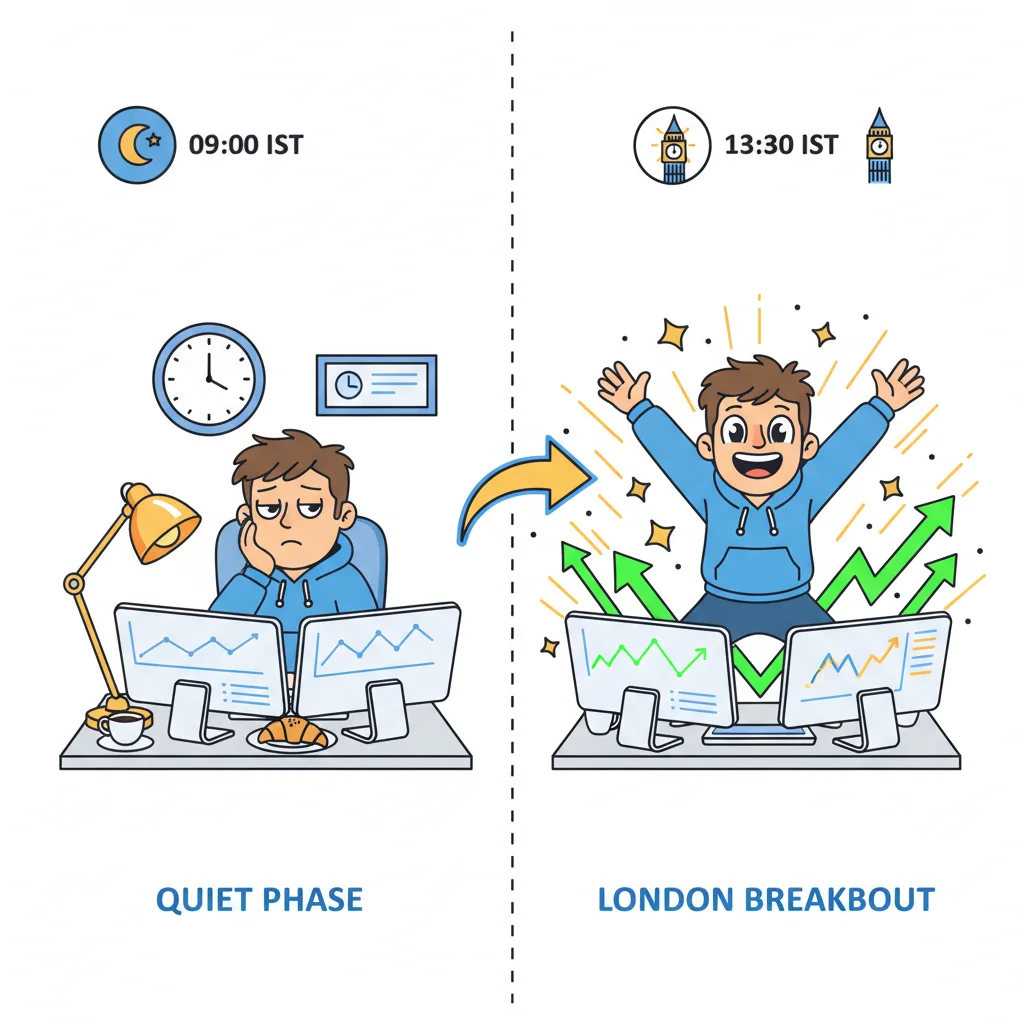
The London Breakout at 1:30 PM IST marks when EUR/INR and GBP/INR experience massive volume surge from European institutional traders, transforming the trading landscape for Indian forex traders.
Strategy 5: Trading RBI Announcements (With Caution)
RBI monetary policy announcements are the most market-moving events for Indian currency pairs. The Monetary Policy Committee (MPC) meets 6 times a year and announces decisions typically around 10:00 AM IST. These create sharp, fast moves in USD/INR.
Now, I want to be straight with you: news trading is the hardest of these five strategies. I've seen experienced traders blow up accounts on RBI days. But done properly, it can work.
The approach I use: Don't try to predict the direction before the announcement. Instead, wait for the initial spike to complete (usually within 2-3 minutes), then look for a 50% retracement of that spike on the 5-minute chart. Enter in the direction of the original spike after the retracement, with a tight stop just beyond the retracement candle's low (for longs) or high (for shorts).
Why wait? Because the first 2-3 minutes after any RBI announcement are pure chaos. Spreads widen, orders get filled at bad prices, and the initial move often reverses partially before resuming. Trying to be first into the market on news is a beginner's mistake that costs money.
For position sizing on RBI days specifically, I'd drop your normal risk to 0.5-1% of account instead of the usual 1-2%. The volatility can easily 2x or 3x your expected stop distance.
RBI announcement dates are published on the RBI website (rbi.org.in) well in advance. Mark them in your calendar for the whole year in January. The next few MPC meetings in 2026 will follow the same schedule, roughly every 2 months.
Disclaimer: This article is for educational purposes only and does not constitute investment advice. Forex and CFD trading carries significant risk of loss. Past performance is not indicative of future results. Always do your own research and consider your financial situation before trading. Never risk money you cannot afford to lose.

Trading RBI announcements with caution—your heart rate charts are more volatile than the forex pairs!
Risk Management: The One Thing That Keeps You in the Game
Every forex trading tip in India eventually comes back to this: how you manage risk is more important than which strategy you use.
The rule I follow, and the one I'd tell any beginner to start with: risk no more than 1-2% of your total trading account on any single trade. If your account is Rs 1,00,000, your maximum loss on one trade is Rs 1,000 to Rs 2,000. That sounds small. It is small. That's the point.
With 1-2% risk per trade, you can lose 10 trades in a row and still have 80-90% of your capital left. You're not out of the game. You get to learn, adjust, and come back.
Three non-negotiable rules for Indian currency futures traders:
- Always set a stop-loss order at the time of entry. Not mentally. An actual order on the system. NSE execution is fast and you will not be able to react fast enough to a sudden RBI intervention move.
- Never add to a losing position. This is called averaging down and it turns small losses into account-killing disasters.
- Keep your use real. Yes, currency futures let you control large notional values with small margins. But that doesn't mean you should use all of it. One lot of USD/INR with a proper stop is fine. Ten lots with a tight stop on a volatile day is a different story entirely.
Track every trade in a journal. Date, pair, strategy used, entry price, stop price, target, result in rupees, and what you observed. After 50 trades, patterns in your own mistakes become obvious. I wish someone had told me this in my first year.