



Are you thinking about running an EA on a prop firm challenge and wondering which ones actually work without getting your account flagged? I've been down this road, and the short answer is: most retail EAs will get you killed before you reach the profit target. The rules prop firms enforce are strict enough that a perfectly profitable EA can still fail a challenge, not because it loses money, but because it hits a drawdown limit on one bad week. This guide covers the best prop firm forex EAs for 2026, the banned strategies that will end your challenge immediately, and the exact steps to set yourself up before you risk a single dollar on a funded account attempt.

Most retail EAs fail prop challenges not from losses, but from hitting drawdown limits. The best EAs balance profitability with strict risk controls to survive each phase.
Why Most EAs Fail Prop Firm Challenges (Before We Talk About the Good Ones)
Here's the thing nobody selling you an EA wants to say out loud: a profitable EA and a prop-firm-compliant EA are two very different things.
I learned this the hard way in 2022. I ran a grid-based EA that had a solid 18-month backtest, roughly 63% win rate, smooth equity curve on paper. Looked beautiful. I put it on an FTMO $25,000 challenge, paid the $155 fee, and it got flagged and terminated within four days. Not because it lost money. Because the algorithm was placing orders at fixed price intervals in both directions, which FTMO classifies as grid trading. Account gone. Fee gone. No appeal.
The real problem is drawdown, not profitability. FTMO's standard rules cap you at 5% daily loss and 10% maximum drawdown. That sounds reasonable until you realize that a legitimate EA with a strong long-term track record might have a 15% drawdown month buried somewhere in its history. That one month would end a funded account.
Prop firms also use automated detection systems. They're not manually reviewing your trades. Algorithms flag patterns like doubling lot sizes after losses, orders placed within seconds of each other, or suspiciously tight order spacing. These triggers can fire even if you didn't intentionally run a banned strategy.
So before you spend money on any prop firm EA, ask yourself three questions:
- Does this EA's worst historical drawdown stay under 8% (giving yourself buffer below the 10% hard limit)?
- Does it avoid martingale, grid, HFT, and latency arbitrage logic?
- Has it been tested on conditions that include realistic spread, commission, and slippage?
If you can't answer yes to all three, stop right there.

Most EAs crash and burn before they even get started. Here's why your robot is about to blow up your account.
Banned Strategies That Get Your Account Terminated Instantly
Every major prop firm publishes a list of prohibited trading methods. Most traders skim this section. Don't.
Martingale is the big one. Doubling (or multiplying) your position size after a losing trade. The logic sounds intuitive but the math is brutal. A string of seven losses at 2x multiplier turns a $0.10 lot into a $12.80 lot. One more loss and you've blown through max drawdown. Firms spot this immediately because the lot size pattern is unmistakable in the trade log.
Grid trading places buy and sell orders at fixed price intervals, creating a mesh of orders around the current price. Some versions are profitable in ranging markets. Doesn't matter. Firms ban it because it can create artificial-looking order flow and it carries catastrophic risk when the market trends hard in one direction.
HFT, meaning trades opened and closed in under five seconds, is banned across most major firms to prevent system overload in their simulated environments. If your EA scalps on tick data or sub-minute timeframes with very fast execution, check the rules carefully.
Latency arbitrage exploits delayed price feeds between brokers. Some EAs are specifically built to detect when a prop firm's demo feed lags behind real market prices. This is considered cheating, full stop. Firms have detection software for this.
Violations don't come with warnings. It's immediate account termination and forfeiture of any profit you've built. I've seen traders post in forums about losing $1,800 in accumulated challenge profits because a single prohibited pattern was detected. The firms don't negotiate on this.

Martingale's devastating math: doubling position size after losses turns a $0.10 lot into a $12.80 lot in just seven trades—one more loss triggers account termination.
The Top EAs That Actually Work for Prop Firm Challenges in 2026
Let's get specific. These are the EAs that have a real track record or strong community verification for automated trading prop firm use.
Forex Flex EA is probably the most prop-firm-aware EA on the market right now. It was built with features specifically targeting FTMO-style challenges: automatic lot size adjustment based on account balance, built-in awareness of minimum trading day requirements, and profit target tracking so it scales down aggression as you approach the goal. This matters more than most people realize. An EA that doesn't know you're three days from hitting the 10% profit target and keeps trading at full size is a liability. Flex knows. It's not cheap, but for funded account automation it's the most purpose-built option available.
Forex Fury sits around $229 and targets conservative traders. Low drawdown, modest gains, very few red flags for prop firm detection. It's not going to wow you with 40% monthly returns (and you should be suspicious of anything that claims that), but it keeps drawdown tight and trades cleanly. If your priority is passing the challenge without a dramatic equity curve, Fury is worth a look.
Quantum Queen is the highest-rated EA on the MQL5 Market as of April 2026, sitting at 4.98 out of 5 from over 400 verified reviews. It trades XAUUSD exclusively. Gold has enough daily range to hit prop firm profit targets reasonably fast, but the volatility is a double-edged sword. You need to be certain its drawdown profile fits within your firm's rules before running it live on a challenge. The community feedback is genuinely impressive, though.
GPS Forex Robot at around $149 is the entry-level pick. MT4 only, conservative settings, low drawdown. It's not going to set records but it's been around long enough to have a real track record. If you're on a budget and running MT4, this is a reasonable starting point.
FXStabilizer PRO at $739 is the premium end. Higher price doesn't automatically mean better results, but this one targets stability specifically, which is exactly what you need for prop firm trading. Worth researching if you're planning to run a high-value challenge ($100k+ accounts).
Honestly, no EA is guaranteed to pass any challenge. These are starting points, not magic buttons.

These are the EAs that actually print money on prop firm challenges (yes, they exist in 2026).
Which Prop Firms Actually Allow EAs in 2026
Not every firm lets you run automated trading at all. Some ban EAs entirely, and you need to check this before buying anything.
The firms that explicitly allow EAs as of 2026:
- FTMO: EAs permitted, with the restriction on martingale, grid, and HFT. Their rules are detailed and publicly available.
- FundedNext: Same permissions as FTMO, same restrictions.
- The5ers: EAs allowed.
- E8 Markets: EAs allowed.
The critical thing to understand is that "EAs allowed" doesn't mean "anything goes." Every one of these firms still enforces the banned strategy list. The permission is for rule-compliant automated systems only.
Some firms ban all automated trading completely. If you run an EA on a firm that prohibits it and they catch you (and the trade pattern analysis often catches you), you lose everything with no recourse.
Always read the terms of service yourself. Don't rely on forum posts or YouTube reviewers to confirm what's allowed. Rules change. A firm that allowed EAs in 2024 might have updated their policy by the time you're reading this. Spend 20 minutes reading the actual rulebook before you spend $200 on an EA license.
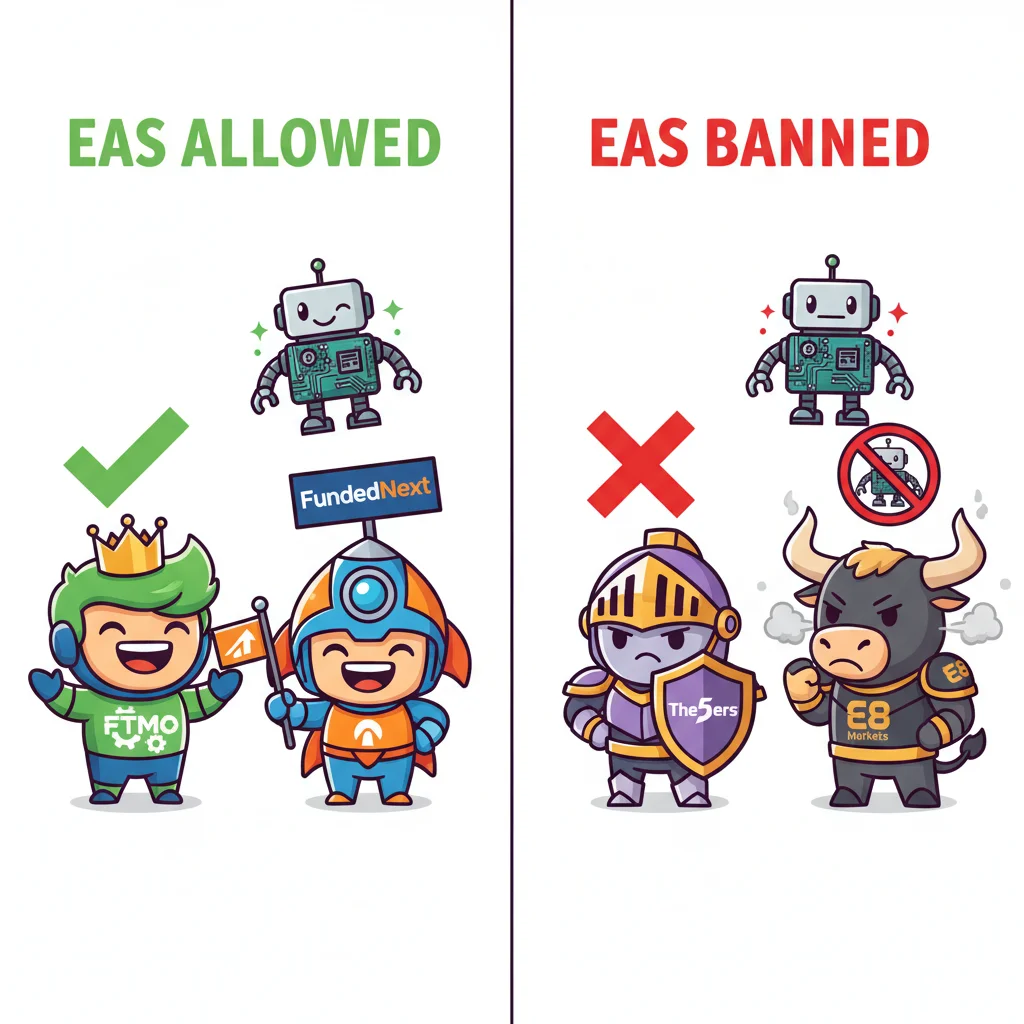
As of 2026, major firms like FTMO, FundedNext, and The5ers explicitly permit EAs—but restrictions on martingale, grid, and HFT strategies still apply. Always verify a firm's automation policy before purchasing any EA.
How to Backtest an EA for Prop Firm Conditions (Most Traders Skip This)
Running a backtest on default settings and calling it done is one of the most common mistakes I see. Default backtest conditions almost never match prop firm trading conditions.
Here's the setup you actually need:
- Use the prop firm's broker spread, not your broker's spread. FTMO and similar firms run on specific liquidity providers. Their spreads on EUR/USD during off-hours can be 2-3 pips, not 0.2 pips. An EA that looks profitable on a tight-spread backtest might actually lose money at real prop firm spread conditions.
- Add commission. Most prop firm accounts charge per-lot commission. If you're not modeling this, your results are inflated.
- Enable slippage modeling. In Strategy Tester on MT4/MT5, set the execution model to "Every tick based on real ticks" if your data supports it. This is slower but far more realistic.
- Test the full drawdown, not just the profit. Pull up the equity curve and find the worst single week. Find the worst single day. That's what matters for prop firm compliance, not the final number.
- Run it over at least 24 months of data, including 2022. The 2022 Fed rate hike period produced unusual volatility that destroyed a lot of EAs. If your EA survived that, it's more credible.
I ran a backtest for a client last year on a popular prop firm EA. Default settings showed 34% annual return. After adjusting for realistic spread and commission at FTMO conditions, it dropped to 11%. Still positive, but barely enough to hit the 10% profit target within the challenge window. Context matters enormously.

Most traders skip backtesting and wonder why they fail. Here's the tedious-but-essential work that separates winners from blowups.
VPS Setup: Why Your Home Computer Won't Cut It
Running an MT5 EA for a funded account on your home PC is asking for trouble. Power outages, internet drops, Windows updates that restart your machine mid-session. Any of these can leave an open position unmanaged.
A VPS (Virtual Private Server) runs your EA 24 hours a day, five days a week without interruption. For prop firm challenges specifically, you want a server located in New York or London. These cities host the major forex liquidity hubs, so your latency to broker servers will be lowest. High latency won't trigger HFT flags on its own, but it can affect execution quality in ways that hurt your challenge performance.
Budget VPS options run around $20-40 per month. For a $155-500 challenge fee, this is not a place to cut corners. BeeksFX, ForexVPS, and Vultr are commonly used by EA traders.
Make sure your VPS runs Windows Server (MT4 and MT5 are Windows applications), has at least 2GB RAM if you're running multiple currency pairs, and has a dedicated IP address.
Phase-by-Phase Action Plan: From Zero to Running an EA on a Funded Challenge
If you're starting from scratch, here's the exact sequence I'd follow.
Phase 1: Research and Selection (Week 1-2) Choose your target prop firm first, not your EA. Read the full rules document. Confirm EAs are allowed. Write down the exact drawdown limits, profit targets, and minimum trading day requirements. Then shortlist EAs that have been publicly verified by real traders in the community, not just vendor marketing pages.
Phase 2: Backtest Under Real Conditions (Week 2-3) Download historical tick data for your chosen currency pair. Set up MT4 or MT5 Strategy Tester with realistic spread, commission, and slippage. Run the EA over 2021-2025 data minimum. Look specifically for the worst drawdown week in the entire test period. If that number exceeds 7-8%, the EA is risky for a 10% hard limit account.
Phase 3: Demo Test on Prop Firm Conditions (Week 3-5) Most prop firms offer free demo accounts or let you run a demo before paying for a challenge. Run the EA here. Watch the actual execution, not just the backtest. Check that lot sizes are appropriate for the account size and that no flagged patterns appear.
Phase 4: Start Small on a Real Challenge (Week 5+) Don't start with a $100,000 challenge. FTMO's $10,000 challenge costs around $155. That's your tuition. If the EA passes, you're funded and can scale up. If it fails, you've lost $155 and learned something real. I've seen traders burn $500+ on large challenges with untested EAs. Don't be that person.
Phase 5: Funded Account Management Once funded, the risk rules are even more important than during the challenge. Lower your EA's risk per trade slightly below challenge settings. You've already done the hard part. Protect the account.
Realistic timeline: 6-8 weeks from zero to running a funded EA account if you're thorough. Rushing this process is how people lose challenge fees repeatedly.
The Honest Reality Check Nobody in the EA Industry Will Give You
I want to be straight with you here because too many people in this space aren't.
Most retail EAs fail prop firm challenges. Not because the developers are dishonest (though some are), but because the drawdown constraints are genuinely tight. An EA that returns 40% annually might have a single 15% drawdown month somewhere in its history. That one month ends a funded account. The expected value on challenge fees can be negative for years before you find a compliant setup.
The price range for legitimate prop firm EAs runs from about $149 (GPS Forex Robot) up to $739 (FXStabilizer PRO), with the most popular options sitting between $229 and $349. That's real money, and you should treat the purchase like any trading expense: only spend what you can justify losing.
Also, past backtest results don't guarantee future performance. Any developer showing you a perfect equity curve in Strategy Tester has access to the same historical data you do. Curve-fitting is real. The EA that backtests beautifully on 2019-2023 data might fall apart in 2026 conditions.
What actually works is finding an EA with a proven, conservative approach, testing it yourself under prop firm-specific conditions, and starting with the smallest available challenge tier. Treat the first challenge as a test, not as a guaranteed income stream.
If you do that, you give yourself a real shot at using the best prop firm forex EAs to build something sustainable. If you skip the process and just buy the most hyped EA you find on YouTube, you're going to fund someone else's lifestyle, not yours.
Disclaimer: This article is for educational purposes only and does not constitute investment advice. Forex and CFD trading carries significant risk of loss. Past performance is not indicative of future results. Always do your own research and consider your financial situation before trading. Never risk money you cannot afford to lose.